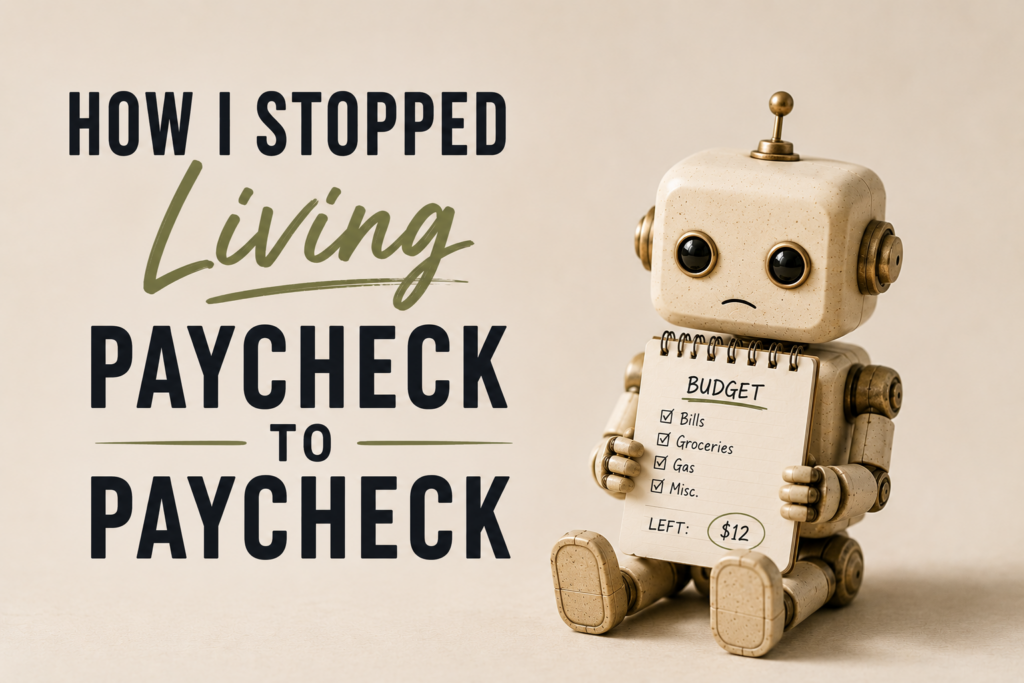
Call me a weirdo, but for years I genuinely dreamed about having one of those impossibly organized financial lives.
You know the type. Beautifully color-coded budget categories. Perfect little pie charts showing exactly where every dollar went. Matching savings accounts with aesthetic names. Spreadsheets that looked like they belonged to someone who meal preps on Sundays and somehow always remembers to cancel subscriptions before the free trial ends.
Meanwhile, my actual money management system was mostly opening my banking app, panicking slightly, moving money around, and hoping nothing bounced overnight.
For years, I honestly believed the problem was that I just had not found the right budgeting method yet. So I kept restarting.
New spreadsheet. New budgeting app. New categories. New monthly reset. At one point I had so many budgeting tools downloaded on my phone that it looked like I was preparing to testify before Congress about my grocery spending habits. And every single time, the same thing happened.
For a few days, I would feel incredibly organized and responsible. I would convince myself I was finally becoming one of those calm adults who tracks spending consistently, plans meals in advance, and probably owns matching baskets somewhere in their house.
Then real life would happen.
Groceries would cost more than expected. A bill would come out early. I would order takeout because everyone was exhausted and cooking felt emotionally unreasonable. Some forgotten subscription would quietly renew itself like a tiny financial ghost living inside my phone. And suddenly the budget felt ruined.
That cycle repeated for years, and the frustrating part was that I did not feel reckless with money. I felt exhausted by money.
There is a difference.
I was constantly trying to “manage” my finances, but my paycheck still disappeared too fast, payday still felt stressful, and I still felt behind no matter how many times I restarted my budget.
That is eventually what pushed me to create the Money Lane System.
I did not create it because I thought the world desperately needed another complicated budgeting framework with color-coded trackers and twelve different spending categories for seasonal beverages. Honestly, I created it because I was tired of feeling financially overwhelmed all the time.
I wanted something simpler. Something lower maintenance. Something that still worked during stressful weeks, busy weeks, expensive weeks, and mentally exhausted weeks. I needed a financial system that could survive real life instead of collapsing the second life stopped behaving perfectly.
Because traditional budgeting had quietly started feeling like another full-time job I was failing at.
Why Traditional Budgeting Failed Me Repeatedly
One of the biggest realizations I had was that budgeting itself was becoming part of my financial stress.
I was constantly checking balances, adjusting categories, remembering due dates, and mentally calculating upcoming bills every time I bought groceries. Even small purchases started feeling emotionally loaded because every dollar was competing with something else in my head.
I remember sitting in a grocery store parking lot one night transferring money between accounts on my phone trying to make sure a payment would not bounce overnight. I had groceries melting in the back seat while I moved tiny amounts around like I was trying to negotiate a hostage release with seventeen dollars.
That was one of the moments where something finally clicked for me.
I did not need another budgeting app.
I needed my money to stop feeling chaotic.
Because by the time I sat down to “budget,” most of the paycheck already felt gone. Bills had already hit. Random spending had already happened. Something unexpected had already come up. I kept trying to organize money after life had already started attacking it from every direction. It was exhausting.
I would avoid opening my banking app some days because I simply did not have the mental energy to deal with whatever number was waiting for me inside it. I would stand in checkout lines doing invisible math in my head while pretending to look completely relaxed externally, which I am sure looked extremely convincing.
Traditional budgeting never really solved that feeling for me because it required constant attention and constant decision-making. Even when I was technically “doing well,” money still felt emotionally noisy all the time.
That is why I eventually stopped focusing so much on tracking money and started focusing more on organizing it.
The Money Lane System Changed How I Handle Money
The biggest breakthrough for me happened when I stopped obsessing over tracking every dollar and started organizing my money before life could touch it.
That became the foundation for the Money Lane System:
- Bills
- Spending
- Future
That simplicity is exactly why it worked.
Instead of trying to micromanage financial chaos after it had already started, I started separating money immediately so each category had a clear purpose before the month could spiral. The difference was immediate – I wasn’t just seeing it but feeling it.
Bills stopped competing with random spending. Future goals stopped getting whatever scraps survived the month. Spending money stopped carrying the same level of guilt because I already knew the important things had already been handled first.
For the first time in years, I stopped feeling blindsided by my own paycheck. I stopped opening my banking app with the emotional stability of someone diffusing a bomb.
And maybe that sounds dramatic, but financial stress quietly follows you everywhere. It follows you into grocery stores, workdays, weekends, relationships, and random Tuesday afternoons when your phone buzzes with a payment notification.
That is why I started writing more openly about financial stress, paycheck-to-paycheck living, budgeting burnout, financial organization, and building simpler money systems that actually survive real life.
If this part feels familiar, you would probably relate to:
- The Hidden Paycheck Trap: Why Payday Still Feels Stressful
- How To Stop Living Paycheck To Paycheck Without Extreme Budgeting
- I Didn’t Realize Financial Stress Was Making Me Sick
- The 3-Lane Method For Escaping Survival Mode
Because for me, the issue was never that I did not care about money. It was that my financial system could not handle real life consistently.
Why Financial Organization Matters More Than Perfect Budgeting
Looking back now, I honestly think a huge amount of my stress came from having all my money mixed together.
Bills lived in the same account as groceries. Savings lived in the same account as random spending. Future goals lived in the same place as emergencies, impulse purchases, and forgotten subscriptions.
Everything overlapped emotionally.
Buying groceries felt stressful because rent also lived there. Spending money felt guilty because savings also lived there. Trying to save money felt pointless because emergencies kept draining the account anyway.
I spent years thinking I needed more discipline when what I actually needed was more separation. That is one of the biggest reasons the Money Lane System stuck for me when traditional budgets did not. It reduced mental load instead of increasing it.
And honestly, reducing mental load changed my finances more than any budget category ever did.
I still buy unnecessary things occasionally. There was absolutely a phase where I convinced myself expensive candles were somehow part of my emotional recovery plan. But the difference is that my money no longer completely unraveled every time life got stressful.
That stability matters more than perfection ever will.
How I Finally Started Creating Financial Breathing Room
I think I used to expect financial progress to feel dramatic.
In reality, mine started much smaller.
I stopped overdrafting as often. I stopped panic-checking my bank account constantly. I stopped feeling guilty every time I spent money. I stopped having as many moments where I looked at my paycheck and genuinely wondered where it had gone two days later.
That was the beginning of things finally changing. Not perfection. Not luxury. Not becoming one of those finance influencers standing beside a white Tesla explaining compound interest with suspicious confidence. Just stability.
And after years of feeling financially stressed all the time, stability felt incredible.
That is also why I eventually expanded the Money Lane System beyond simply separating money. Once things stopped feeling chaotic, I realized real financial progress came from creating structure that kept moving money forward consistently instead of rebuilding from scratch every month.
That shift completely changed how I thought about budgeting, cash flow management, financial organization, and long-term financial stability.
For years, I thought financial stability would make me feel like a boss. I thought it would feel dramatic and impressive, like I would suddenly become one of those adults who calmly reviews investment accounts while drinking expensive coffee at home.
Honestly, it felt much quieter than that.
It felt like not getting a knot in my stomach every time my phone buzzed with a payment notification. It felt like buying groceries without mentally calculating six upcoming bills at the same time. It felt like my paycheck finally lasting long enough for me to breathe a little.
And after years of feeling financially overwhelmed all the time, that kind of calm ended up feeling better than “boss” ever would have.
If you are trying to simplify your finances and stop feeling overwhelmed by money, these posts are a good next step:
- How I Created Financial Breathing Room After Years of Budgeting
- Why Payday Habits Matter More Than Budgeting
- The Simple Money System That Finally Made Our Finances Feel Manageable
- How To Organize Your Finances Without A Budget Spreadsheet
- The Best Bank Account Setup for Managing Money Without Budgeting
Because I honestly no longer think most people need stricter budgets.
I think many of us just need a financial system that still works when life gets messy.