I used to think I needed more discipline with money.
Really, I needed less chaos.
Every payday felt the same. Money came in, bills swallowed most of it, a few unexpected things happened, and suddenly I was checking my account before buying groceries again. I was moving money around, restarting budgets, trying not to overdraft, mentally calculating bills while trying to sleep, and promising myself next month would finally be different.
The problem wasn’t that I didn’t care about money.
The problem was that my entire financial life depended on me paying attention all the time.
I’m the type of person who actually likes being organized. I love planners, lists, fresh starts, all of it. But I could never seem to stay on top of my finances day after day when life got busy or stressful. I needed something that kept my money organized even when I wasn’t.
That eventually became the foundation for the Money Lane System.
1. Separate Your Money
The biggest thing I changed was separating my money instead of keeping everything in one account.
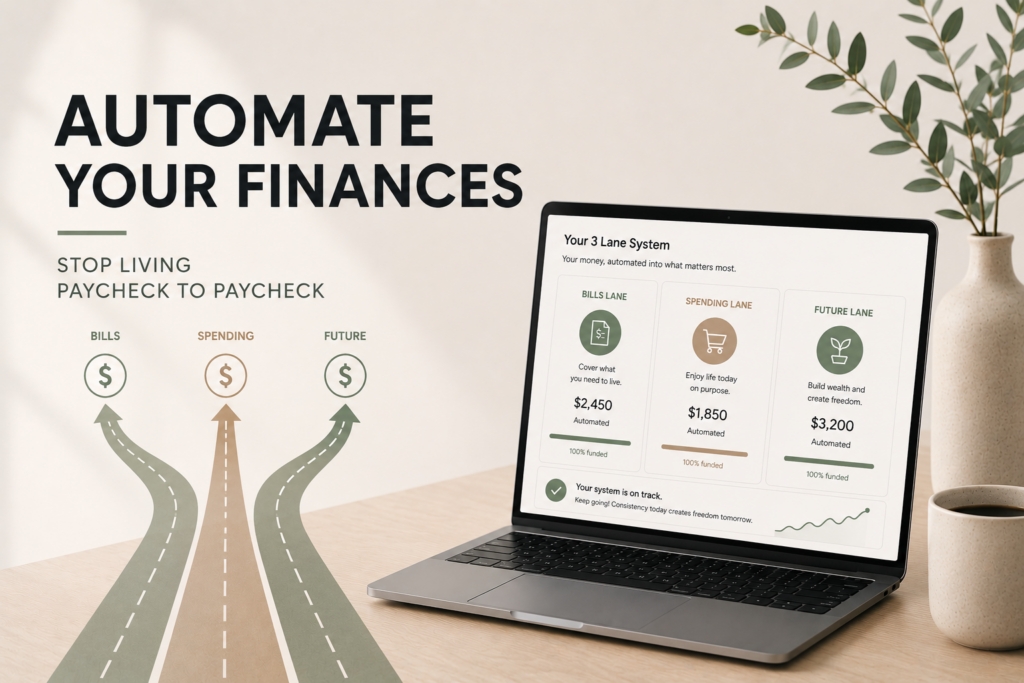
I split it into three accounts:
- bills,
- spending,
- and future money.
Before that, every purchase felt stressful because technically the money was there, but I never knew what it was supposed to cover. I’d stand in the grocery store silently trying to remember whether the internet bill had already come out yet, or if buying a few extra things would mess something up later in the week.
Once my bills had their own place to sit, my brain got quieter. I stopped mentally sorting through my entire financial life every time I used my debit card.
That separation is really the core of the Money Lane System — organizing money before life spends it for you.
If you’ve ever wondered why payday still feels stressful even when you just got paid, this is a huge reason why. When everything mixes together, your paycheck never actually feels safe.
2. Automate Your Expenses
The next thing I did was automate as many bills as possible.
Not because I’m naturally organized. Honestly, I’m not.
I just got tired of carrying due dates around in my head. I used to wake up in the middle of the night suddenly remembering a bill and grabbing my phone half asleep to make sure it had cleared.
Even when nothing was technically wrong, my brain never fully relaxed.
Automating bills removed a huge amount of mental noise. Things stopped falling through the cracks because my finances no longer depended entirely on memory and exhaustion.
3. Move Money On Payday Immediately
This part changed everything for me.
The second I get paid, my paycheck gets divided between my three accounts automatically: bills, spending, and future money. I do not leave everything sitting in one place anymore because I already know what happens when I do. Life starts grabbing pieces of it before I’ve even had a chance to think clearly.
I used to tell myself I’d organize my money “later,” but later usually meant after groceries, takeout, gas, Amazon purchases, school expenses, or random stress spending after a long day. By the time I finally looked at my account properly, the paycheck already felt smaller and harder to control.
Once I started moving money immediately, payday stopped feeling so chaotic. My bills account handled bills. My spending account told me what I could safely use without panicking. My future account slowly started building breathing room in the background instead of getting whatever happened to be left over.
The biggest shift for me was realizing the problem wasn’t always overspending. Sometimes the problem was simply that my financial decisions were happening too late.
4. Stop Rebuilding Your Budget Every Month
I didn’t realize how emotionally draining it was to constantly restart financially.
I was always trying new spreadsheets, new budgeting apps, new tracking methods, new “fresh starts.” Then one hard week would happen and the whole thing would collapse again.
I needed something that still worked during bad weeks.
Before, one unexpected expense made me feel like I had failed financially all over again. Now the important things already happen automatically, so bad weeks don’t completely destroy everything.
That’s also why I talk so much about topics like “Why Budgeting Fails For Most People (And What Works Better)” and “The Best Money Management System For Beginners.”
A lot of people do not need stricter budgets.
They need less financial friction.
5. Make Saving Automatic
I stopped waiting until I had “extra money” to save because honestly, extra money rarely appeared.
So instead, I automated small amounts first. Nothing dramatic. Just enough to start creating a little breathing room between me and constant financial panic.
And emotionally, that changed more than I expected.
For the first time, it stopped feeling like every paycheck only existed to clean up problems from the last one.
One day I realized I bought groceries without checking my balance first. That sounds small, but it didn’t feel small to me.
6. Reduce The Number Of Financial Decisions You Make
This might honestly be the biggest thing I learned.
I stopped trying to manually make perfect money decisions all day long.
Automation reduced stress spending, forgotten bills, overdrafts, panic, and financial avoidance. I used to avoid opening my banking app because I already knew seeing the balance would ruin my mood. My finances constantly felt loud because everything depended on me actively managing it all the time.
Now my money feels quieter.
I still have bills. Life is still expensive. Unexpected things still happen.
But my money no longer feels completely out of control all the time.
That’s what the Money Lane System is really built around.
Not perfect budgeting. Not financial perfection. Just helping normal people create a financial life that feels calmer, clearer, and easier to stay on top of even during hard seasons.