My nonna had an envelope for everything.
There was grocery money in one envelope. Money for the paper boy in another. Cash folded neatly into an old shoebox under her bed. A coffee can tucked at the back of the kitchen cupboard with extra bills inside. Heavy jars of change sitting on top of the fridge that I could barely lift as a kid.
And savings.
Always savings.
Not investing apps. Not spreadsheets. Not budgeting software. Just money separated on purpose.
I remember spending an entire rainy weekend sitting at her kitchen table rolling coins with her. Pennies, nickels, dimes, quarters. Little paper wrappers everywhere. The sound of coins clinking against the table while she told me stories about growing up in Italy as a little girl.
At one point, I asked her what all the change was for.
She smiled and said, “Vacation fund.”
And it really was. A few months later, she used that money to buy round-trip tickets to Italy.
That memory stayed with me because I slowly realized the envelopes and jars were never really about the money itself. They were about peace of mind.
My grandparents liked knowing there was cash tucked away somewhere. They liked seeing savings physically exist. They liked knowing grocery money was already set aside before they even walked into the store. There was comfort in that. Not because life was easy or because they had endless money, but because things felt accounted for before problems showed up.
I think we lost some of that somewhere along the way.
Now money moves invisibly. Bills auto-withdraw. Subscriptions quietly pile up in the background. We tap debit cards and phones all day long without physically seeing money leave our hands. Entire paychecks disappear digitally before we even fully process where they went.
And somehow, despite all the convenience, money feels emotionally heavier now.
A lot of us carry our finances around in our heads constantly. We stand in grocery store aisles mentally calculating whether the insurance payment already came out. We check the banking app before buying basic things. We move money between accounts trying to repair the month after overspending. We lie awake mentally subtracting bills while trying to sleep.
It’s exhausting in a way that’s hard to explain unless you’ve lived like that for a long time.
And honestly, I think that’s a huge reason digital envelope budgeting and digital cash stuffing have exploded in popularity recently. Deep down, I think many of us are trying to recreate some of that calmness our grandparents had. We want our money organized before life starts happening instead of trying to clean up the mess afterward.
For me, digital envelope budgeting feels like the modern version of what nonna was already doing with those envelopes and jars years ago.
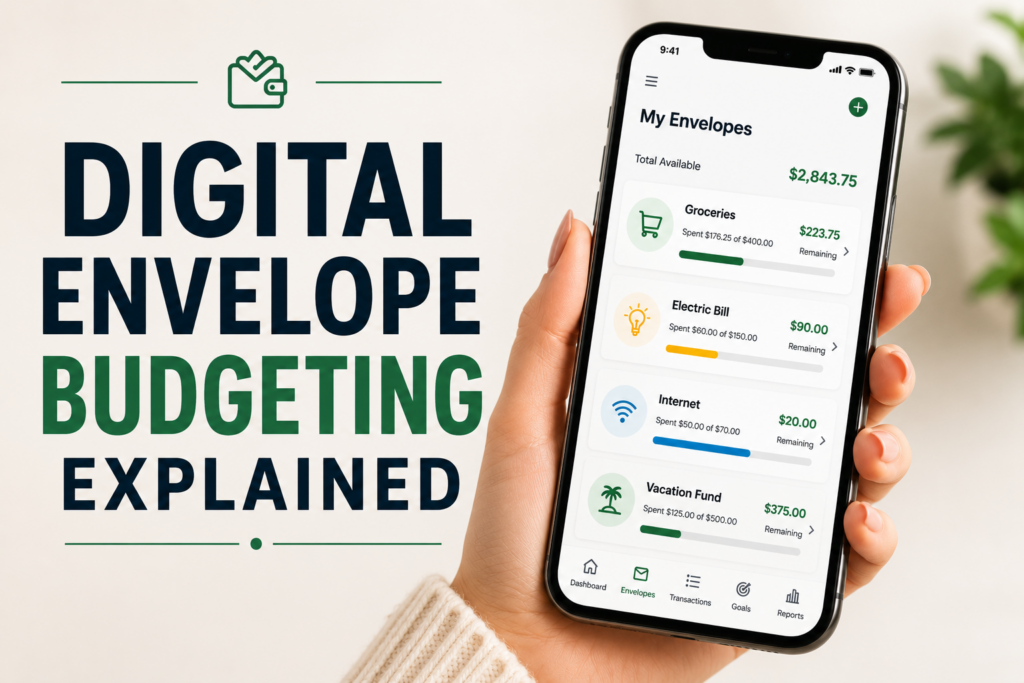
Instead of physically separating cash, we separate money digitally before we spend it. Bill money stays separate from grocery money. Spending money stays separate from savings. Future money stays protected from random daily life.
That separation changes things emotionally in a way I don’t think traditional budgeting advice talks about enough. When all our money sits together in one account, every purchase starts carrying emotional weight because everything is competing against everything else all month long. Even if the math technically works, nothing feels fully safe to spend.
But when money already has places to go, our brains stop trying to hold every financial detail at the same time.
Honestly, that realization became a huge part of why I wrote the Money Lane System.
For years, I thought I needed more discipline. Better spreadsheets. Better budgeting apps. Better tracking habits.
Meanwhile, life kept happening anyway.
There was the emergency plumbing bill because my three-year-old decided to teach her stuffed animal how to swim in the toilet. Around the same time, we ended up needing a completely new electrical panel just to accommodate a heating system upgrade we hadn’t fully planned for financially yet. And somewhere in the middle of all of that came the realization that our oldest was going to need braces.
And honestly, sometimes it wasn’t even the big expenses that got to me the most.
Sometimes it was transferring money from savings to checking for something small and immediately feeling guilty about it afterward. Or buying takeout after an exhausting day and hearing that little voice in my head asking whether that was irresponsible.
That constant mental pressure wears you down over time.
Eventually I realized the problem wasn’t that I didn’t care about money. The problem was that everything was mixed together. Every dollar was competing against every other dollar all month long inside one giant financial pile.
That’s when I started thinking about nonna again.
Separate the important things first. Protect future money first. Stop making every dollar fight for survival inside the same account.
That became the foundation for the Money Lane System:
Bills. Spending. Future.
Simple lanes for money instead of constant financial pressure.
That’s also why my posts like How to Track Spending Without Budgeting Every Dollar, How To Organize Your Finances Without A Budget Spreadsheet, and The Best Bank Account Setup for Managing Money Without Budgeting connect with people so deeply.
Most of us are not looking for tighter financial control.
We’re looking for less mental chaos.
And honestly, digital envelope budgeting works because it brings back some of the emotional clarity our grandparents naturally created with cash envelopes and savings jars. When grocery money is already separated, groceries stop feeling emotionally dangerous. When bills already have their own space, we stop wondering whether rent money quietly disappeared through a hundred tiny purchases during the month. When savings sit separately, we stop accidentally spending them every time life gets stressful.
And because it’s digital, automation becomes incredibly easy. We can automate bills, emergency savings, sinking funds, vacation savings, debt payments, and future goals so money quietly moves where it needs to go before we have the chance to accidentally spend it somewhere else.
That matters because life gets busy. We get tired. We get emotionally drained. Complicated financial systems usually fall apart during stressful seasons of life. Simple automated separation keeps working anyway.
Honestly, a simple setup usually works best. One account for bills — with as many bills automated as possible — one account for spending, and one account for savings and future goals. That alone creates more clarity than a lot of detailed budgets ever did for me.
This is also why the three-lane setup inside the Money Lane System focuses so heavily on separating money before daily life absorbs it.
Because when money has boundaries, life stops feeling quite so financially noisy.
And honestly, I don’t think there’s anything wrong with jars of change and wads of money tucked away somewhere safe.
In fact, I encourage it.
Cash is still king in a lot of ways.
And just like nonna, I still throw all my spare change into a jar at home too. Although these days, I never seem to collect very much because nearly all my purchases are digital now.
But maybe that’s part of the point. Maybe what we’re really missing isn’t the cash itself. Maybe we’re missing the feeling of calm that came from knowing exactly where our money was going.