I was pretty good in school.
Maybe not straight-A good, but close enough that I assumed adulting would come naturally to me. I was practical. Responsible. Fairly smart. I followed rules, handed assignments in on time, and generally had my life together.
So naturally, I assumed budgeting would be easy too.
Uh-uh.
Maybe it’s because math was always my least favorite subject. Or because I’ve never been a paperwork sort of girl. But for years, budgeting made me feel weirdly incapable in a way that other parts of adulthood didn’t.
Because technically, I understood how budgets worked. Spend less than you make, track your spending, and be responsible.
Simple in theory.
Except somehow every budget I made eventually ended up abandoned in a drawer, forgotten in an app, or emotionally avoided like a text message from someone asking if you’ve “thought more about the opportunity.”
I think a lot of women quietly feel this way about budgeting because women already live under ridiculous standards in almost every area of life. We’re supposed to maintain a house like an Instagram trad wife who makes her kids cereal by growing the oats first, remember every appointment and somehow arrive five minutes early, look selfie-ready at all times, answer everyone’s texts, manage everyone’s emotions, stay healthy, keep the groceries stocked, and still have the mental energy to manually track every dollar we spend forever.
At some point, I realized the problem wasn’t that I didn’t care about money. I cared a lot. I wanted to stop overspending, pay off debt, stop feeling anxious every time I checked my bank account, and actually have money left at the end of the month besides whatever survived groceries and random late-night Amazon decisions.
What finally changed things was realizing I needed a simpler way to organize my money before life spent it for me.
That realization eventually became the foundation for the Money Lane System — separating money ahead of time so bills, spending, debt payoff, and future savings stop competing with each other constantly.
That felt far more realistic than trying to maintain perfect budgeting behavior for the rest of my life.
If you already read “The Best Budgeting Method for People Who Hate Budgeting,” this is kind of the next layer of that conversation. And if you haven’t read “The Real Reason Budgeting Doesn’t Work for Most People,” start there first because it explains why so many budgets quietly collapse after a few stressful weeks.
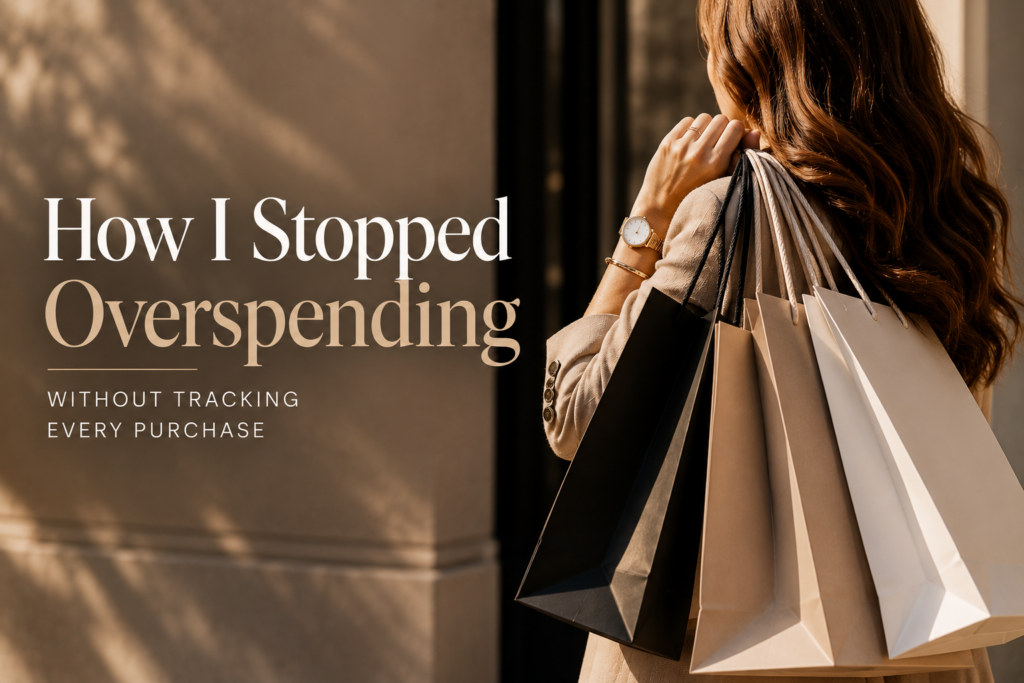
These are the things that actually helped me stop overspending without tracking every purchase. Not perfectly, but realistically.
1. How Separating My Money Into 3 Accounts Reduced Overspending
The biggest change I made was separating my money into three accounts for bills, spending, and future goals because it immediately stopped me from accidentally spending money that already had another purpose — something I explain much more deeply inside the Money Lane System.
Before that, every dollar sat together in one account like a chaotic financial soup. I would check my balance and think I had more room than I actually did because technically some of that money already belonged to rent, groceries, debt payments, or upcoming bills.
Separating everything forced clarity. My spending money finally became visible instead of imaginary, which meant I stopped constantly wondering whether I could actually afford something or whether I was about to financially sabotage next week without realizing it.
That mental stress slowly made me tune out financially. It wasn’t that I didn’t care. I had too much to care about already.
Something as simple as picking up a loaf of bread had quietly turned into this exhausting mental process of checking balances, remembering upcoming bills, estimating what was left, and replaying recent purchases in my head to make sure I hadn’t forgotten something important.
Once I separated my money properly, I finally felt normal again. That loaf of bread didn’t feel like a gotcha scenario anymore.
2. Why Emotional Exhaustion Was Secretly Driving My Impulse Spending
Most of my overspending happened when I was mentally drained.
Late-night Temu shopping. A random throw blanket at Winners because apparently I needed a fifth beige throw blanket to emotionally survive winter. Drive-thru food after exhausting days.
And honestly, am I really that terrible of a person for wanting one overpriced frappe a week?
Some financial advice makes women feel like buying one candle or iced coffee is the reason they’re not retiring at 42. Meanwhile, most of us are just trying to make it through Thursday without crying in a grocery store parking lot.
Once I started paying attention to when I overspent, the pattern became obvious. It almost always happened after stress, exhaustion, overstimulation, bad days, or emotional overload.
Because I was tired. Because I needed comfort. Because I craved the kind of dopamine shot that comes from curling up on the couch, scrolling through cheap crap I don’t need, and adding it to cart.
Not because I was irresponsible. That’s a very different problem.
3. The Realistic Budgeting Method That Worked Better Than Tracking Every Dollar
Tracking every purchase made me think about money constantly, and not in a healthy way.
Every grocery trip became stressful. Every coffee carried guilt. Every tiny purchase turned into a weird internal debate that lasted longer than the purchase itself.
Eventually I would stop tracking for a few days, then avoid opening my banking app entirely because I already felt behind again.
What worked better was creating boundaries before spending happened so I didn’t have to micromanage every transaction afterward. Once my spending money sat separately from my bills and future goals, I stopped mentally calculating purchases all day long.
I stopped standing in Walmart mentally subtracting groceries from upcoming bills like I was trying to solve an advanced math equation beside the yogurt section, and honestly, that alone reduced so much financial stress.
I finally felt normal again instead of feeling like every grocery trip was some kind of financial performance review.
4. Why I Kept Restarting Budgets Like a January Diet
Every Christmas break, I would create massive January financial plans like I was about to emerge into the new year as a completely transformed woman.
New budget. New routines. Color-coded categories. Financial goals. Meal planning. Probably yoga somehow. I even bought pretty markers and gel pens for this stuff. I know… I know.
By February, I was usually rebuilding the entire thing again. Budgeting started feeling a lot like crash dieting. Too strict. Too obsessive. Too unrealistic for actual life. You can force almost anything for a few weeks when motivation is high, but that doesn’t mean it fits your real personality or your real life long-term.
And every time the budget collapsed, I blamed myself instead of questioning whether the approach itself made sense.
That’s exactly why I wrote “The Best Budgeting Method for People Who Hate Budgeting” because I know how exhausting it feels to keep restarting financial plans over and over again.
5. How I Reduced Impulse Spending Without Turning Into a 1950s Housewife
A lot of budgeting advice still quietly expects women to become these endlessly disciplined domestic financial managers who hand-wash freezer bags, make a week’s worth of baked oats for the whole family, cook every meal from scratch, and somehow never get tired.
That was never going to be me.
I wasn’t going to suddenly transform into a woman who happily meal preps twelve mason jar salads while jazz music plays softly in the background.
Instead, I focused on reducing the number of emotional spending decisions I had to make every week. I automated bills, simplified my accounts, reduced financial clutter, and stopped relying on willpower every time I walked into a store stressed, hormonal, overstimulated, tired, or emotionally done with humanity for the day.
Which realistically covered a large percentage of adulthood.
6. The Money Habit That Finally Made Me Feel Less Financially Panicked
The biggest shift wasn’t mathematical. It was emotional.
I stopped feeling like every purchase might secretly ruin my month because I could finally see where my money was supposed to go before life started grabbing from it randomly.
I stopped bracing myself before checking my Visa balance and wondering what disaster I forgot about this time.
That constant low-level panic started fading.
If this part resonates with you, I also wrote “How to Organize Your Finances Without a Budget Spreadsheet” and “The Best Bank Account Setup for Managing Money Without Budgeting” because financial organization reduced my stress far more than strict budgeting ever did.
7. Why Simpler Money Systems Work Better for Overwhelmed People
I spent years trying to force myself into budgeting systems that required constant attention, constant tracking, and constant emotional energy.
Eventually I accepted that I needed something simpler. Something low-maintenance enough to survive busy weeks, burnout, unexpected expenses, and normal human behavior.
I think a lot of people need that. Not another spreadsheet. Not another budgeting app. Not another guilt cycle. Just a calmer way to manage money that helps them stop overspending, pay off debt, save money more consistently, and finally feel less overwhelmed by their finances.
That’s exactly why I created the Money Lane System in the first place. Not to make people obsess over money more, but to help money feel clearer, calmer, and easier to manage in real life.