I remember the first time I managed to save what felt like a meaningful amount of money.
It wasn’t sitting in a high-interest savings account or part of some carefully designed financial plan. It was cash folded into an old makeup bag tucked into the back of my sock drawer.
Looking back, the amount itself wasn’t what mattered. What mattered was what that money represented. For the first time in a long time, I felt like I had a little breathing room. If something went wrong, maybe I wouldn’t have to immediately reach for a credit card. Maybe I wouldn’t have to spend days moving money around and hoping everything cleared at exactly the right time.
That’s why I think emergency funds matter so much. They aren’t really about the money itself. They’re about having options when life inevitably decides to throw something expensive in your direction.
The problem is that building an emergency fund is much harder than most financial advice makes it sound, especially when you’re living paycheck to paycheck. Many posts assume there’s extra money available somewhere. Maybe not a lot, but enough to steadily build savings over time. That wasn’t my experience at all. When money was tight, I wasn’t deciding whether to save or spend. I was deciding which important thing would get funded this month and which important thing would have to wait.
That’s one reason I often point people toward How to Stop Living Paycheck to Paycheck Without Extreme Budgeting. Until you create some breathing room in your finances, almost every financial goal feels harder than it should.
Why Building an Emergency Fund Feels So Hard
Most people don’t struggle with emergency funds because they don’t understand the concept. We all understand the basic idea: save money, prepare for unexpected expenses, and avoid debt when emergencies happen.
The challenge isn’t understanding it. The challenge is finding room for it.
When you’re living paycheck to paycheck, every dollar already has somewhere it needs to go. Rent needs to be paid. Groceries need to be bought. Gas tanks need to be filled. Prescription refills need to be picked up. School fees need to be paid. By the time the necessities are covered, there often isn’t much left.
That’s what makes saving feel so frustrating. Every dollar that goes into an emergency fund is a dollar that could solve a problem today. When you’re already juggling competing priorities, it’s hard to justify setting money aside for a problem that may or may not happen later.
Why So Many Emergency Funds Fail Before They Ever Grow
For years, I assumed people struggled with emergency funds because they weren’t saving enough. Now I think the bigger problem is that most emergency funds are expected to do far too many jobs.
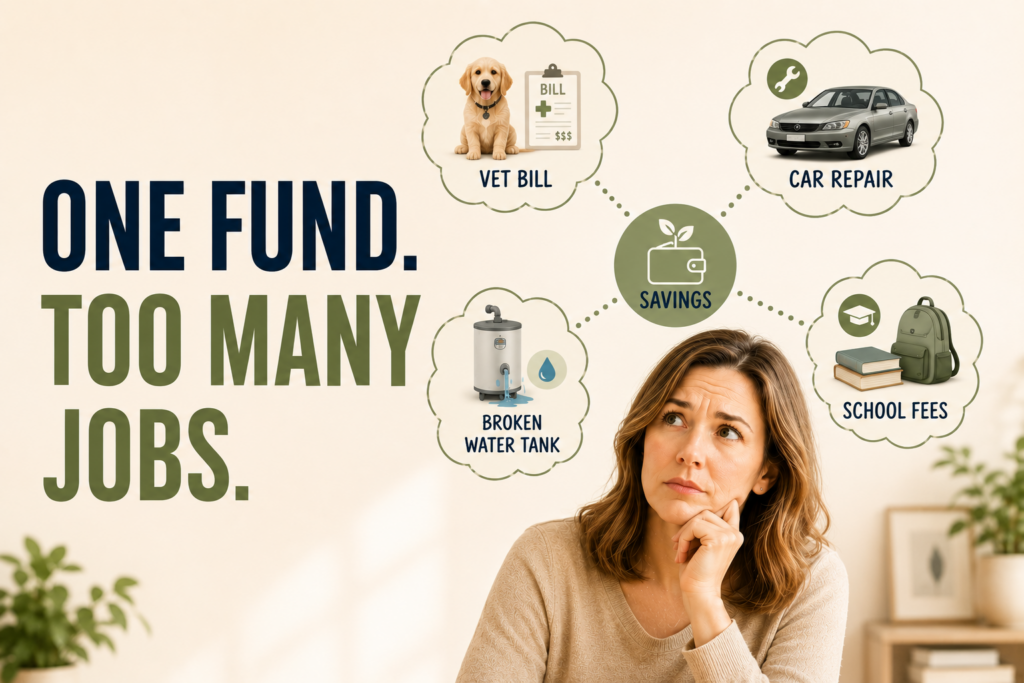
A single savings account often becomes emergency money, Christmas money, vacation money, pet expense money, vehicle repair money, home maintenance money, and future goal money all at the same time. Everything gets thrown into one account because there’s nowhere else for it to go.
Then life happens. The dog needs veterinary care. The car needs brakes. School registration comes due. A household appliance breaks unexpectedly. The balance drops, and it feels like months of progress disappeared overnight.
Of course it feels that way. One pile of money is trying to solve six different problems.
The more I thought about it, the more obvious it became that many people don’t actually have an emergency fund problem. They have a money organization problem.
The Difference Between an Emergency and an Expected Expense
This was one of the most important financial lessons I ever learned.
A hot water tank suddenly leaking rust-colored water across the basement floor is an emergency. Replacing a sump pump during a storm because the basement is beginning to flood is an emergency. Losing a job is an emergency. Those are the situations emergency funds are designed to handle.
Your dog’s annual vaccinations aren’t an emergency. Christmas isn’t an emergency. School supplies aren’t an emergency. Vehicle maintenance isn’t an emergency either. That doesn’t mean those expenses are easy to pay for or that they aren’t stressful. It simply means you know they’re coming. Maybe not on a specific date, but eventually.
The moment I started separating expected expenses from actual emergencies, my entire perspective changed. I stopped trying to make one savings account carry the weight of every future financial responsibility.
When Everything Feels Like an Emergency
Of course, understanding the difference doesn’t instantly solve the problem.
When you’re financially stretched, everything feels urgent. I remember postponing expenses I knew were coming simply because there wasn’t room for them right now. Then, when they finally arrived, they felt like emergencies even though they weren’t.
That’s what happens when money gets tight enough. The line between expected and unexpected starts to blur. The annual furnace service feels like a crisis. The vet bill feels like a crisis. The vehicle repair feels like a crisis. Not because those things are emergencies, but because there’s no money specifically waiting for them.
That’s also why emergency funds often disappear gradually instead of all at once. It usually isn’t one catastrophic event. It’s a series of expected expenses, cash-flow problems, and financial pressures that slowly chip away at the balance until there’s very little left.
If this article resonates with you, these related articles explore other pieces of the same financial puzzle:
- Why Saving Money Still Feels Impossible (Even When You Cut Expenses)
- The Real Reason You Never Feel Ahead Financially
Why Emergency Funds Don’t Create Financial Stability By Themselves
For years, I believed that if I could just save enough money, I’d finally feel financially secure. Then I watched people with emergency funds still stress about money. I watched people with savings accounts still dread payday. I watched people with money in the bank continue to feel overwhelmed by their finances.
Eventually, I realized that an emergency fund is one piece of financial stability. It isn’t financial stability itself. Financial stability comes from knowing where your money is supposed to go before it arrives. It comes from having a plan for expected expenses, bills, emergencies, and future goals.
It also becomes easier when every dollar doesn’t have to compete with every other dollar. Giving money a specific purpose before it arrives reduces decision fatigue and makes unexpected expenses far less disruptive. That’s one reason so many people relate to Why Traditional Budgeting Fails for So Many People.
For example, imagine having money set aside specifically for vehicle repairs, home maintenance, pet expenses, and emergencies. Suddenly a vet bill doesn’t feel like your emergency fund failed. The money came from a category that was designed to handle it. The emergency fund remains intact because it was never supposed to cover that expense in the first place.
If you’ve read some of my other posts, you’ll know that I’ve spent years dealing with a chronic illness. At one point, there was a treatment option that might have helped reduce some of the pain and improve my quality of life. The treatment itself wasn’t the problem. The problem was everything that came with it.
It would have required travel, hotel stays, meals away from home, and time away from work. When you’re already struggling to keep your finances together, those extra costs can feel overwhelming. It’s hard to turn down something that might bring relief, but sometimes survival comes first.
Looking back, that decision had less to do with the size of my emergency fund and more to do with how fragile the rest of my financial situation felt. I didn’t just need emergency savings. I needed a financial system that made everyday life feel less precarious.
If you’ve ever gotten paid and somehow still felt stressed two days later, you’ll probably relate to The Hidden Paycheck Trap: Why Payday Still Feels Stressful. The paycheck itself usually isn’t the problem. What happens after the paycheck is where many people get stuck.
The Real Problem I Was Trying to Solve
Eventually, I stopped asking how to build a bigger emergency fund and started asking a different question: why did managing money feel so exhausting?
Why did every financial decision require so much thought?
Why did I need to remember everything?
Why did one account balance have to represent bills, spending money, savings, future expenses, and long-term goals all at the same time?
The answer turned out to be surprisingly simple. Everything lived together. There was no distinction between money for bills, money for emergencies, money for future expenses, and money for long-term goals. It all sat in the same place competing for attention.
Bills sat beside spending money. Emergency savings sat beside future-expense money. Savings sat beside money that was already spoken for. Every dollar competed with every other dollar because there was no separation.
That’s when I realized I didn’t actually have an emergency fund problem. I had a money organization problem.
My emergency fund wasn’t failing because I wasn’t saving enough. It was failing because it was being asked to do too many jobs. It wasn’t just emergency money anymore. It was vehicle-repair money, Christmas money, pet-expense money, home-maintenance money, and future-goal money all competing for the same space.
That’s the realization that eventually became the Money Lane System. I didn’t create it because I wanted a better budget. I created it because I was tired of one pile of money trying to solve every financial problem in my life. The entire system grew out of a need to give different categories of money different jobs so emergencies, bills, future expenses, and long-term goals stopped competing with one another.
How to Build an Emergency Fund That Actually Lasts
The biggest change for me wasn’t finding more money. The biggest change was reducing the number of things my emergency fund had to cover.
Once expected expenses started getting their own attention, the emergency fund became easier to protect. Once bills had a clear place, the emergency fund became easier to protect. Once future goals stopped competing with emergencies, saving started feeling less like maintenance and more like progress.
This is also why traditional budgeting never worked particularly well for me. The issue wasn’t a lack of discipline. The issue was trying to manage too many competing priorities inside the same pool of money.
The more organized your money becomes, the less pressure your emergency fund has to absorb.
Your Emergency Fund Probably Isn’t the Problem
If you’ve struggled to build an emergency fund, I don’t automatically think you’re bad at saving money. I think there’s a good chance you’re trying to make one pile of money do too many jobs.
That’s what I did for years.
Most emergency funds don’t fail because people don’t care. They fail because people are trying to create financial stability with one account while expected expenses, emergencies, bills, and future goals are all competing for the same dollars.
The goal isn’t just to save money. The goal is to create enough separation that your emergency fund can finally do the job it was designed to do.
Most people don’t need a bigger emergency fund as much as they need a better system for managing expected expenses, bills, and future goals. That’s exactly the problem the Money Lane System was designed to solve.